Tips From Social Media Pros – Building Your Personal Brand & More

This week, I had the opportunity to listen to some social media marketing professionals answer questions posed by myself and my fellow classmates. Hearing their personal experiences, getting their interview tips, and taking a closer look at their day-to-day lives in the digital workplace was a really valuable experience, and it’s one of the many reasons I love Marquette.

After telling my Mom and my older sister about the panel (both of which also attend some form of college), I realized that other schools don’t always provide their students with such rich experiences! I learned a lot from the pros, and I’m really glad I got the chance to sit down with them and hear first-hand about some of the exciting work I’ll get the opportunity to do in the near future.

When it came time to write my list of questions, I had a hard time coming up with ones that I felt were good enough – like I said, how often does one get the chance to ask direct questions to professionals in their field? I wanted to make sure that I’d get the most out of my opportunity.

But after I sat with my laptop open for fifteen minutes, I decided to stop overthinking it and just ask the things that I most want to know if I’m really considering working in social media. What’s the worst part about it? How do you fight creative slumps and continuously find inspiration for marketing campaigns?

Luckily, although I only got the opportunity to ask one question, my classmates asked many other valuable ones that were similar to those I had on my own list. Here’s what I wanted to know, and here’s what I learned from the experience:

My Questions:

  1. How stressful would you rate your job on a scale of one to ten?
  2. What was your biggest social media challenge, and what did you learn from it?
  3. What is an example of a campaign or project that didn’t go exactly as planned and what did you learn from it?
  4. How do you fight creative slumps and continuously find inspiration for campaigns and content creation?
  5. Which organizations do you recommend college students get involved in while they prepare for a career in social media?
  6. What are some tips you have for building your personal brand that may help put you ahead post-graduation when searching for jobs?
  7. What tips for networking with other social media professionals do you have?
  8. What skills do you recommend college students work on as they prepare to enter the social media field?
  9. How do you develop social media campaigns so far in advance knowing that social media is a constantly changing environment?
  10. What are the best and worst parts about your job?

The Takeaways

The question I ended up asking was #6 – tips for building a personal brand while in college. Recently, I have been really interested in the idea that social media allows people to build entire brands around themselves. I love that the internet makes it profitable for people to create content surrounding their passions, and I wanted to know what I can do to help myself establish and grow a personal brand.

Maggie Avram, one of the social media professionals on the panel, took my question and gave me some solid advice. Maggie noted that much of the advice she’d offer individuals about how to build a brand is the same advice she’d offer to big companies. She told me that creating content around a passion is a really huge part of being good at what you do and connecting with others who have similar interests is a great way to grow online.

Listening to the community of people that you create content for is also really important. Making connections with an audience while simultaneously developing content creation skills is a great combination of experiences to put on a resume! I really appreciated what she had to say – I’m excited to start putting some of these ideas into action.

From listening to the pros field the other questions from my classmates, I learned a lot more about the social media marketing world than I thought I could in a mere hour and a half. I learned about how to beat writer’s block with a small timer, what kinds of follow-up questions to ask in interviews, and how campaign creators keep up with the ever-changing world of social media.

I now feel better equipped to practice connecting with others online, following trends, and staying on top of what’s happening in the digital world. This was a really valuable classroom experience, and I feel confident going forward about which skills I should be developing and how to do that in preparation for post-graduation job hunting.

Before I go, I want to extend a super sincere thank you to the professionals who loaned us their time and provided us with valuable advice. It’s reassuring to hear the highlights of what working in social media is really like, and I’m more motivated than ever to learn how to use it in the most efficient, creative ways possible.
Effective Advertising Made Me Genuinely Consider Butt-Masking

Listen – I’m pretty open to trying new things, especially when it comes to self-care. I’ve tried face masks, hair masks, body scrubs, beauty supplements, and pretty much every other beauty-related item you can think of. The one product I haven’t yet added to my routine, however, is a butt mask. Yes, you read that right – a mask for your butt.

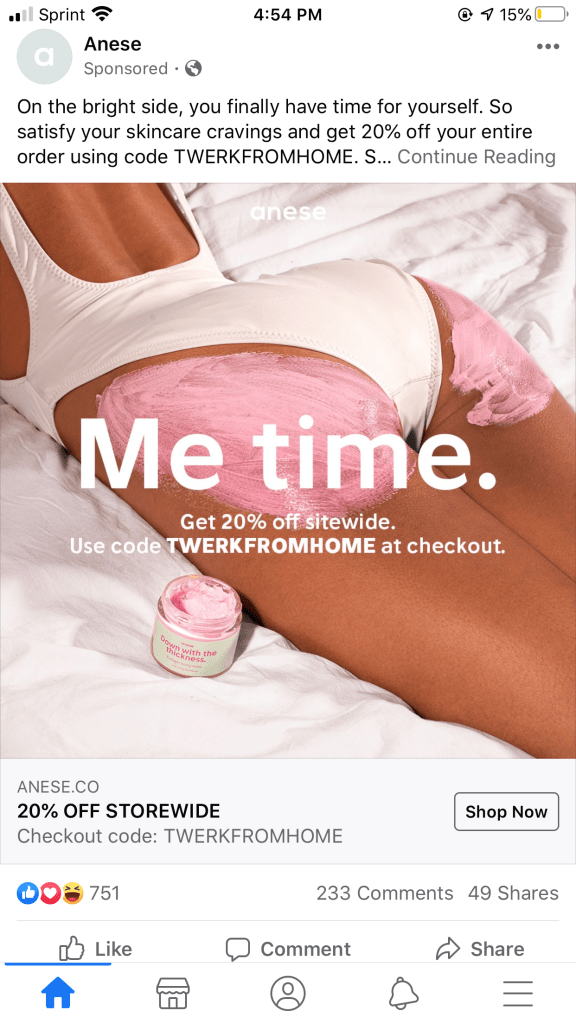
Anese is a small, indie skincare brand that sells scrubs and masks meant to fight cellulite, reduce the appearance of stretch marks, soften the skin, and reduce acne – all on your backside. Their packaging is minimalist, pink, and really cute, which checks all the boxes for things I typically impulse-buy. I’ve got to say, I’m kind of a picky consumer to advertise to, but this whole butt-masking thing definitely caught my attention as soon as it showed up in my Facebook feed. Without their strategic use of Facebook’s advertising tools, I probably would have never heard of Anese. They’re such a small brand that I probably just wouldn’t have found then organically. However, when I scrolled through my social media and saw this, I knew I had to check it out:

I mean, do you blame me? Seriously, though, this is an effective ad for the target market Anese is trying to reach. I definitely think that this advertisement is focused on the conversion part of the consumer journey, considering they have a “Shop Now” button placed at the bottom and also provide a coupon code for 20% off site-wide. Their goal here is to entice consumers with the discount and easy access to their website in order to convince them to order. As for advertising objective, I think it was also conversion. This ad is specifically placed and designed to push consumers to visit the website via the Shop Now button and place an order using the discount code provided in the ad. The photo of the woman using the mask stops potential customers in their scrolling tracks, and the promotional code combined with the direct link drives sales. In my opinion, it hits the nail on the head in terms of being attention-grabbing as well as providing motive for consumers to follow through to their site and make a purchase.

Anese definitely caters to women like me – ages 18 to 40, potentially heavy social media users, interested in skincare, makeup, self-care, and not afraid to try new things. Their products cater to badass women who live busy lives, potentially working or in school, who like to go the extra mile with their skincare routine when they finally have time to pause and take care of themselves. Their marketing strategy is bold, which matches the personality of their target consumers. They have a spunky, confident, IDGAF attitude about their brand, so I definitely think they try to target women who share with those traits.

Not gonna lie, I’m kind of interested in taking a closer look at this brand’s products. That tells me that this ad is effective – it’s eye-catching, uses colors and graphics that appeal to the target market, and makes it easy for consumers to view their products and get them for a discounted price. This was advertised to me on my Facebook page, so obviously I’m part of the target market. I stopped, looked at it, and proceeded to click through, which means they accomplished their goal by placing it in my feed.

The second ad I looked at was from a brand called Soko Glam, and it showed up in my Instagram timeline:

This ad felt more awareness related to me. Soko Glam is a retailer that sells Korean skincare and beauty products from other brands through their own platform, so they don’t really advertise their “own” products. In addition, they have less than 400,000 followers on Instagram, so I’m assuming they’re still working toward building brand awareness and bringing traffic to their website (the marketing objective). Through introducing an additional brand’s product that is now available on their website, they are able to reach consumers who may already be fans of that brand and convince them to shop on Soko Glam to find other related products. Their “Shop Now” button is also placed at the bottom of the ad, which makes it convenient for potential consumers to click and shop, increasing their traffic.

Soko Glam’s target market is similar to that of Anese – women, ages 18 to 45, who are interested in clean makeup, clean skincare, Korean beauty trends, and probably social media. They target consumers who are willing to spend more than the average person on a skincare routine, because they offer a wide array of different products. Since a fully-stocked skincare routine can be expensive and time-consuming, they probably don’t market to women with super busy family lives, swamped school schedules or those who prefer a more simplified, drugstore-available product collection.

I think this ad is effective for the business because it gives consumers an idea of the types of products that Soko Glam sells, and encourages them to click through to their website to view more. This ad, when effective, does accomplish the goal of introducing more people to the brand as well as increasing website traffic and the potential for actual sales.

Both of these advertisements, in my opinion, are effective for their intended purposes. I think Anese did an overall better job at capturing my attention and convincing me to visit their website, but I also think I align more with their target market than that of Soko Glam. It was interesting to analyze both of these ads from different marketing objective standpoints, because although they’re similar, they’re intended for different purposes. I haven’t really taken the time to look into something like this before. By the way, I’ll update this post if I actually ever try butt-masking.

GameStop Shows Consumers What They Really Value with COVID-19 Response – Spoiler Alert: It Isn’t Their Employees

We’re living in a strange time right now, huh? This is the most unusual event that I have ever experienced in my life. In 2009 when the H1N1 pandemic hit, I’ll admit I was privileged enough to hear about it on the news but not really concern myself with being personally affected. This time around, things are much different. We’re all affected, and we have no choice but to concern ourselves with protecting our own health and safety as well as that of those we live, work and play alongside.

When things are so uncertain and scary for everyone, the way that brands navigate dealing with COVID-19 speaks volumes about what their values are and how much they care for their customers and employees. I’ve seen a lot of brands make a lot of choices so far regarding COVID-19 (some good, and some, uh, not so good) and it is interesting to see how responses vary across the board. I saw a tweet recently where someone expressed that in their next job interview, they’re going to ask what the company did to protect their employees during COVID-19. I’ll probably add that same question to my follow-ups; if a brand does not conduct themselves responsibly during this time, I can’t trust they’ll have my best interests as an employee in mind. I can’t find the original post, but if I do, I’ll link it here.

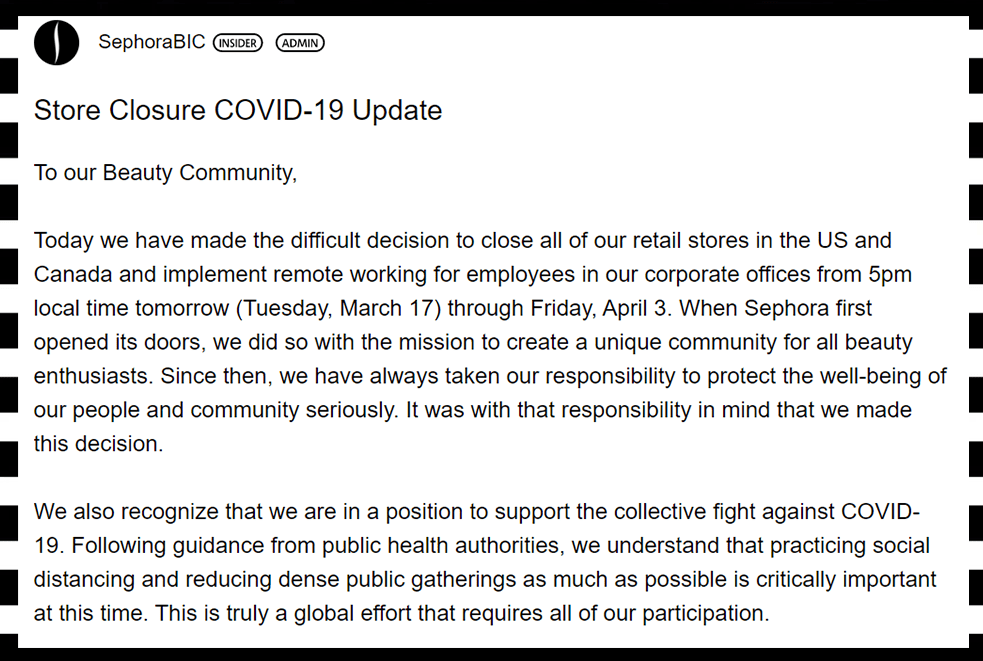
One brand that I think has handled the situation very responsibly is Sephora. Sephora is a multinational chain of beauty stores that sells products related to skincare, hair care, and makeup. I’ve been shopping at Sephora for years, so they’re a brand I really trust. Last week, Sephora posted a COVID-19 statement on their website that outlined the steps they’re taking to prevent the spread of the virus. Here’s the opener to the post:

They start by saying they’ve made the decision to temporarily close all of their retail stores and help corporate employees work from home until April 3. “We have always taken the responsibility to protect the well-being of our people and community seriously,” they say. “It was with that responsibility in mind that we made this decision.”

The rest of the statement details some of the other changes Sephora is making, like offering free shipping to customers for the duration of the closure, uploading more online content for consumers to watch, and adjusting their return policy to aid customers who cannot visit their local Sephora retailer. They also reiterate that their Beauty Insider Community and Customer Service team will always be available to chat. I really love the way that Sephora put the health and safety of both their employees and their customers first, and waiving shipping fees helps customers who may be financially struggling due to the virus. This is a really good example of a company flexing their corporate responsibility to protect their community in more ways than one. Well done, Sephora! Other companies should probably take notes.

GameStop is one of those brands. Although they have now decided to close their retail locations following massive backlash about their initial response, the way they handled the situation from the beginning was just bad. This article has all the details, but here’s what I pulled out:

Like, what? They felt so strongly about staying open that they wanted the police to call their headquarters if they had a problem with it? Not only was it odd that they tried to argue their products are “essential,” but the games that they buy, rent and sell come in cases that are touched by multiple people. This Buzzfeed article noted that “customers purchase plastic disc cases that employees can’t disinfect because they ran out of cleaning wipes.” Gross, but also just irresponsible. GameStop did not have the health and safety of their employees or customers in mind until people pointed out that they should. In comparison to the ways other brands are preemptively reaching out to customers, explaining their decisions and implementing changes to make this easier for everyone, GameStop fell really short.

Instead, they should have followed suit and closed their retail locations. Staying open goes against the rules of social distancing and puts multiple people at risk of contracting the virus. Not to mention they had to be bullied into acting responsibly – now, no matter what changes they made or will make, everyone already knows they originally did not care. It waters down their efforts considerably. Do better next time, GameStop.

I’m hoping everyone is practicing healthy habits and staying safe! I know this is a strange, hard time for everyone. ♡

Influencer Mix Reflection

Let me start off by saying that this midterm project was a lot of fun. It came with challenges, sure, but overall I felt like it was a great, real-world way to practice my skills! I’m excited to have been able to help put together a project that I can use as part of my portfolio in the future. Wantable was a great client to work with, and I feel like having Sam and Lindsey in class with us was really helpful. They really helped my group and I narrow our objectives and nail our strategy down.

My favorite part about this project was looking for the influencers. It was tough to wade through the ridiculous amount of amazing women on Instagram to really find people that I felt would work well for Wantable’s mix, but I had fun looking at all of their blogs. I am inspired by how many women are building careers independently and using the internet to do it! It kind of makes me want to start a blog of my own.

Overall, I believe that my group communicated well, and we had an easy time combining our ideas into one cohesive project. That can be tough when you work in groups sometimes, so it was a good feeling knowing we were all on relatively the same page to begin with. I think we all worked hard and contributed a lot to the finished product. It was fun to bounce ideas off of each other and I’m proud of the work we did together.

I am looking forward to working with Wantable again! I thought this project was a really awesome opportunity.

Milk Makeup Influencer Mix

For this week’s assignment, I chose to put together an influencer mix for one of my favorite makeup brands, Milk Makeup. I started learning about all things beauty, fashion, makeup and skincare when I was twelve years old, so I actually had a ton of fun putting this mix together. Influencers have, well, influenced my interest in the beauty world for years, so spending a few hours at a coffee shop scouring social media to curate a collection of beautiful people who share my interests wasn’t all that bad.

According to my light Wikipedia research, Milk Makeup was launched in 2016 and is based in New York. The line includes several makeup and skincare products, including foundations, eyeliners, mascaras, bronzers, moisturizers, and my personal favorite, the Lip + Cheek in the shade Werk. So good. The vibe of the brand has been relatively consistent since the launch – it has a natural, fresh, urban feel, so I focused my attention on influencers who match that. Here are five influencers who I believe could help Milk Makeup grow:

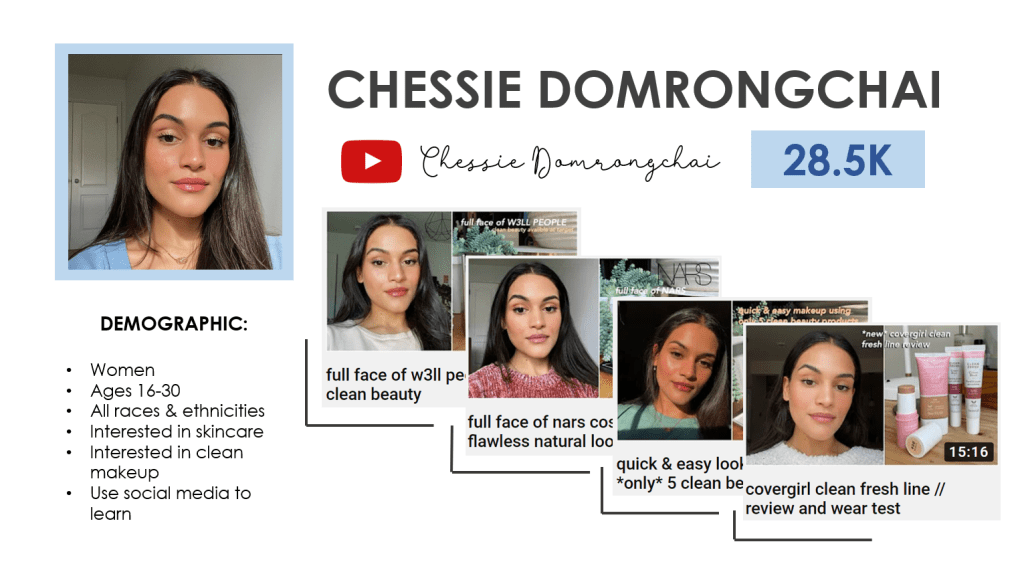
Influencer #1: Chessie Domrongchai

Chessie Domrongchai is a 23-year-old woman from North Carolina who uploads makeup tutorials and reviews to her YouTube channel. With more than 28,000 subscribers, Chessie is considered a micro-influencer, but she has already collaborated with brands that see her potential. Her videos feature makeup brands that are similar to Milk Makeup, and the fresh-faced looks she creates coincide nicely with the glowy, clean feel of Milk’s line of products. In this mix, I allocated $3,500 of my $10,000 budget to Chessie. In return for the compensation, I would request two YouTube videos and an Instagram post. In the first video, she will do a full face of makeup using Milk Makeup products. This fits in nicely with her typical upload style, as she frequently does full-face looks from individual brands. The Instagram post will be a photo of her wearing all of the Milk Makeup products. In the second video, she will review the skincare products from Milk’s line. She has the largest audience size of all of the influencers I chose, so she will receive the most compensation for her work.

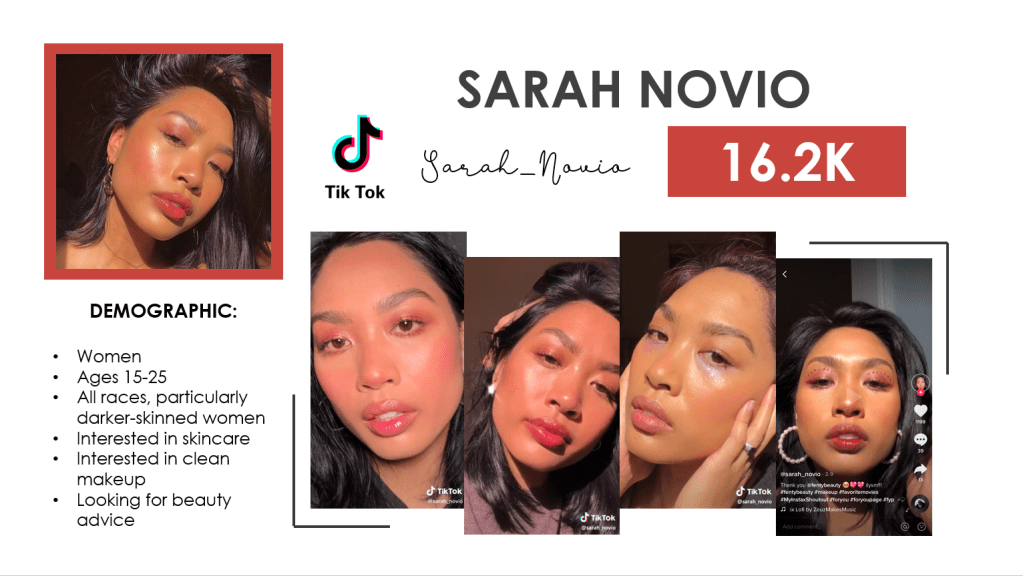
Influencer #2: Sarah Novio

Sarah Novio is a young woman who makes short skincare and makeup videos on the platform TikTok. She is also a micro-influencer with a reach of just over 16,000 people. She has also collaborated with other brands similar to Milk Makeup, and her MO is also gorgeous, glowing skin and clean beauty. I chose to compensate Sarah with $1,000 of the $10,000 budget in exchange for two TikTok videos. In the first video, Sarah will use skincare products from Milk Makeup’s line like the new Vegan Milk Moisturizer and Vegan Milk Cleanser. In the second, she will use products from Milk’s makeup line to create a unique makeup look. Her followers specifically look to her for skincare and makeup recommendations, so she is the perfect influencer to choose as part of this mix.

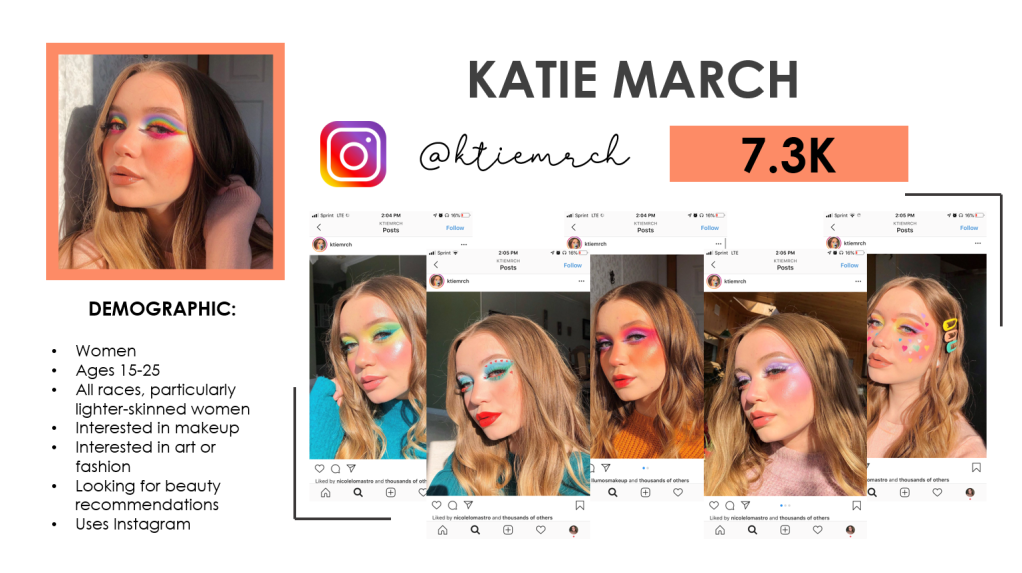
Influencer #3: Katie March

Katie March is a 20-year-old woman who creates gorgeous makeup looks and posts them to her Instagram account. Her creativity and artistic ability, in my opinion, will gain her a lot of attention online in the months and years to come. She is an extremely talented makeup artist, so I knew I had to include her in the mix. Katie will be compensated $1,500 for two Instagram posts using Milk Makeup products and promoting them in the caption of the photo. She fits the vibe of Milk Makeup well because she expresses herself uniquely through her artistry. Katie represents a different type of beauty consumer in comparison to the first two influencers I chose, so she adds a unique, creative element to the mix.

Influencer #4: Yadira Marquez

Yadira Marquez is a young Chicana woman who influences through both her Instagram account and her YouTube account. She, similar to Katie March, is also a creative makeup artist that expresses herself through her work. In this mix, Yadira would be compensated $2,500 for a YouTube video and an Instagram post. In the YouTube video, Yadira would integrate products from Milk Makeup into a creative look and then review the products. In the Instagram post, Yadira would use Milk Makeup products, tag the brand in the photo, and promote the products in the caption. Her presence on two platforms rather than just one is helpful, which is why she is compensated more than some of the other influencers.

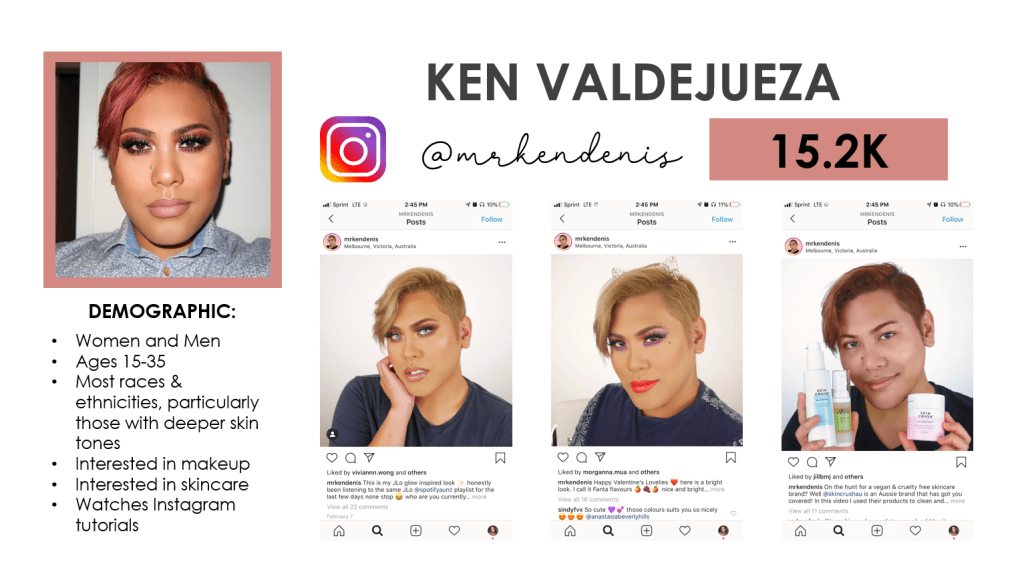
Influencer #5: Ken Valdejueza

Ken Valdejueza is a young man from Melbourne, Australia, who is interested in skincare and makeup. He expresses himself through his gorgeous makeup artistry on his Instagram page. There, he posts both photos and short videos of himself testing and using makeup and skincare products. I chose Ken to be a part of this influencer mix because I think that he uniquely attracts both women and men who are interested in skincare and makeup, so he diversifies the demographic a bit more than the others. I would compensate Ken $1,500 for an Instagram photo and a short video utilizing Milk Makeup products. I think that the style of his page is a little different than the others, so he brings a unique element to the mix.

I had a really fun time searching for smaller influencers to promote Milk Makeup in this mix. I now have a few more people to follow on my social channels, and I learned a lot more about skincare and makeup in the process of reviewing their content! Creating the introduction slides for everyone provided me a chance to be creative with my design skills, too, which was a new experience for me! I look forward to learning more about putting together influencer mixes and how influencers can work with brands to simultaneously achieve success.

How Women Showed Up In Super Bowl LIV

If it isn’t obvious by the female symbol tattooed on my forearm, I love strong women. I always get excited when women break boundaries, and in 2020, I’ve already seen some badass women do some really amazing things. This year’s Super Bowl was no exception – women showed up in all kinds of spectacular ways for the Big Game, so I decided to dedicate an entire infographic to them. Take a look:

Women now make up almost half of the NFL’s fanbase, and an openly gay woman was one of the assistant coaches on the field; it was the first time in history that’s ever happened. Women from all over the world joined the conversation about the Super Bowl online, and two Latina women had the whole globe watching when they performed the halftime show. That’s pretty powerful. Diversity was a strong theme throughout the game, including the advertisements, many of which featured women who belong to different minority groups. Several articles published after the Super Bowl highlighted the ways in which women are making an increasing impact on football, evident in the statistic that shows the female fanbase is up 5% from last season.

To make this infographic, I collected data from both the presentation we utilized in class as well as an article from CNBC and another from Time Magazine. Canva made it really easy for me to pick a layout, change the color scheme, add some graphics, and download it as a high-quality image. I’ve never used Canva before, (or really made anything like this) but the process was made super simple with their website! I’d imagine I’ll be using it again sometime soon.

All in all, I had fun collecting statistics that really show just how much of an impact women are making, even in a male-dominated sport. I’m anticipating even more diversity, culture, and girl-power in next year’s game.

Olay’s Super Bowl Ad – Powerful or Patronizing?

I’m not a huge sports fan. Every year, I get more excited about the Puppy Bowl than the actual football game (I’m an eighteen-year-old girl, who can blame me?). On Sunday, in fact, I timed my drive back to Milwaukee from Appleton so I’d be on the road right as the game started; it was my most traffic-free drive yet. I didn’t watch a second of the game, but I made it home in record time and still got the gist of the halftime show courtesy of people fighting on my Facebook timeline. Jokes aside, despite the fact that I don’t care about the game itself, I am still a sucker for a great Super Bowl commercial. I know other people can relate – it’s almost half the fun of the event. Companies who pay for airtime during the game really have to put their best advertising foot forward, because with just under 100 million people watching, there’s a lot of pressure to come up with something impactful.

Olay opened an interesting dialogue with their collaboration with Girls Who Code, an organization that teaches young women computer skills and helps encourage them to pursue jobs in computer science. The commercial featured five women, including Nicole Stott, Lily Singh, Busy Phillips, Taraji P. Henson and Katie Couric, all working together to send three women to space. The message of the ad was simple – make space for women! Olay, in addition to airing a seemingly empowering advertisement for millions of people to see, also promised that for every time the ad was shared on Twitter using the hashtag #MakeSpaceForWomen, they’d donate $1 to Girls Who Code. Here’s the ad, in case you haven’t seen it yet:

At first glance, I really liked this ad. It felt empowering, it highlighted a variety of successful women, and it promised to support the educational development of young women interested in STEM. I’m a young feminist, so I figured, what’s not to love? Turns out, there are a few things people weren’t super keen on.

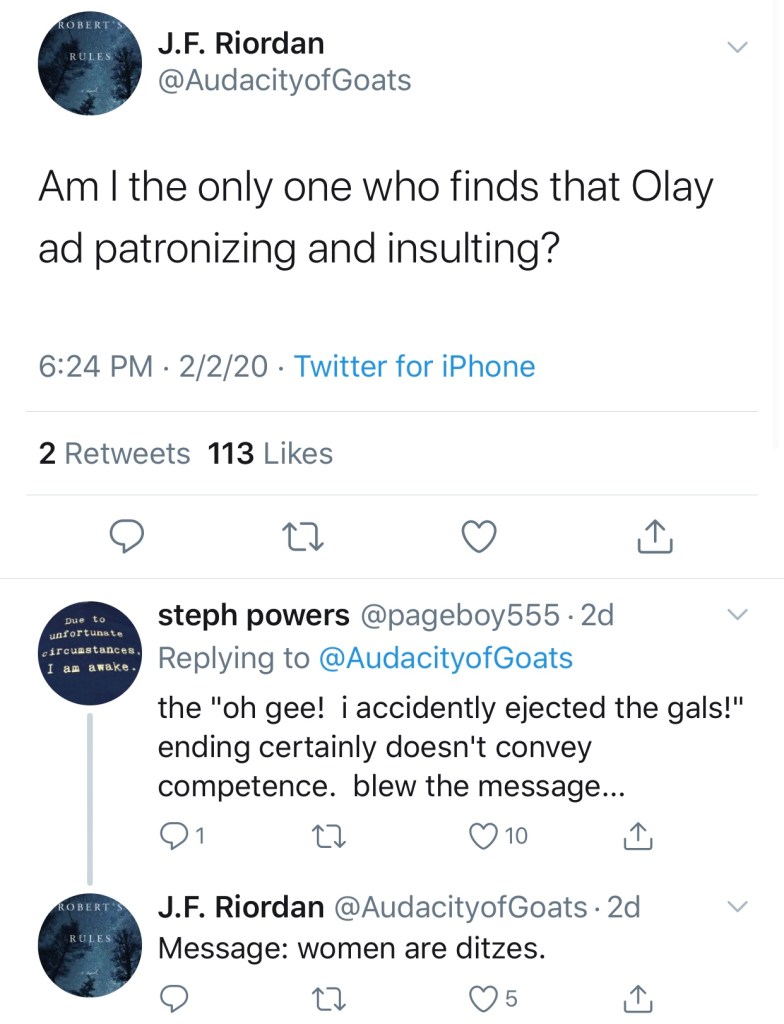
I went to Twitter to gather some opinions, searching “Olay ad” and looking at the top posts. Most of these posts were other celebrity women praising the ad, sharing the hashtag and encouraging other women to do the same. It seemed to me that other people also loved the commercial – in fact, the data we looked at in class confirmed that Olay had one of the most successful campaigns in terms of positive sentiment. To be clear, most of the comments were positive, many of them applauding Olay for supporting Girls Who Code and bringing women into the spotlight of computer science. Others, however, felt that the commercial was too cheesy for such an important topic, even making women seem “ditzy” after one of them accidentally hit the eject button in the space craft at the end of the ad. Several Twitter users expressed that the end of the ad sort of “blew the whole message,” and that Olay’s money may have been better spent elsewhere. Here’s an interesting exchange I saw:

I hadn’t considered this point of view before I came across it online. I have to say, I kind of agree! The whole ad did feel a little silly after I watched it again with a new perspective. I still like the concept and I support a partnership with Girls Who Code, but the creative direction and planning for this campaign could have taken the issue more seriously and portrayed women in a more professional light.

Another issue several users brought up on Twitter was the fact that Olay guaranteed a donation to Girls Who Code, but only up to $500,000. Several people pointed out that it was a pretty skimpy contribution considering Olay had over five million dollars to spend on their advertisement – couldn’t they have just donated that to Girls Who Code instead? I’ll say this also impacted my opinion about the advertisement as a whole. Again, I agree – not only did Olay turn some women off with their ditsy portrayal of women in science, but they turned others away with their seemingly selfish financial priorities. I understand the company has to spend advertising dollars for their own benefit, too, but why spend so much money on telling people you’re donating rather than just donating? It was an interesting point to consider, and many online shared their thoughts about it. Here are a few examples I saw:

I see what Olay was trying to do. Really, I do! Honestly, I think any ad campaign that focuses on supporting young women and organizations that help young women is worth paying attention to. But in 2020, it is more important than ever for ads like this to portray women in ways that don’t counter constant social efforts to help women be taken seriously. Also, people are right to be skeptical about the amount Olay donated. The ad itself cost ten times more than the amount they’re donating – was it really a great allocation of their resources? That’s up for debate.

In general, the collaboration with Girls Who Code was well-supported by comments that I saw on Twitter, so although the skit for this ad wasn’t received well by everyone, at least a donation will be made to an organization that promotes intelligence and professionalism in young women. If you’re interested in learning more about Girls Who Code or donating to their cause, I’ve linked to their website. You can click here to go to their donation page.

Confronting My Unhealthy Relationship With Social Media

It’s 7:00 AM. My alarm goes off, and I wake up to snooze it. This happens a few more times before I’m actually coherent, but as soon as I am, it’s straight to social media I go. I have the same routine every morning, groggily staring into the bright light of my phone and scrolling through the last eight or so hours of posts that I’ve missed while I was sleeping. Admittedly, it usually isn’t much, so I get out of bed and make breakfast, do my makeup or work on my laptop for a while before I go to school. Of course, I watch new YouTube videos or listen to the latest episode of my Podcast series while I get ready – then it’s Spotify through my headphones on the way to class. In the first two hours of my day, I have already spent the majority of my time connected to my phone.

After class, I pack up my books, put my coat back on, plug in my headphones and immediately check my text messages and social media platforms again. It’s probably only been an hour since I last scrolled, but what if there’s more? I walk home and scroll, scroll, scroll, ignoring the city bustling around me while I like Ashley’s new selfie on Instagram and find a cheesy motivational quote on Pinterest to send to my boyfriend. My day goes on and on like this – check Instagram, check Facebook, check Twitter, check TikTok (for two hours, because although I know I have homework waiting for me at my computer, what’s a few more minutes?). When I do eventually sit down at my desk to read a textbook, answer an email or submit a discussion assignment, if my phone isn’t face down and on silent, I will check it. Like magic, my motivation and focus both disappear into thin air – surely, this Buzzfeed quiz about which Bath and Body Works candle I am is far more important than my assignment right now. I can always read tomorrow.

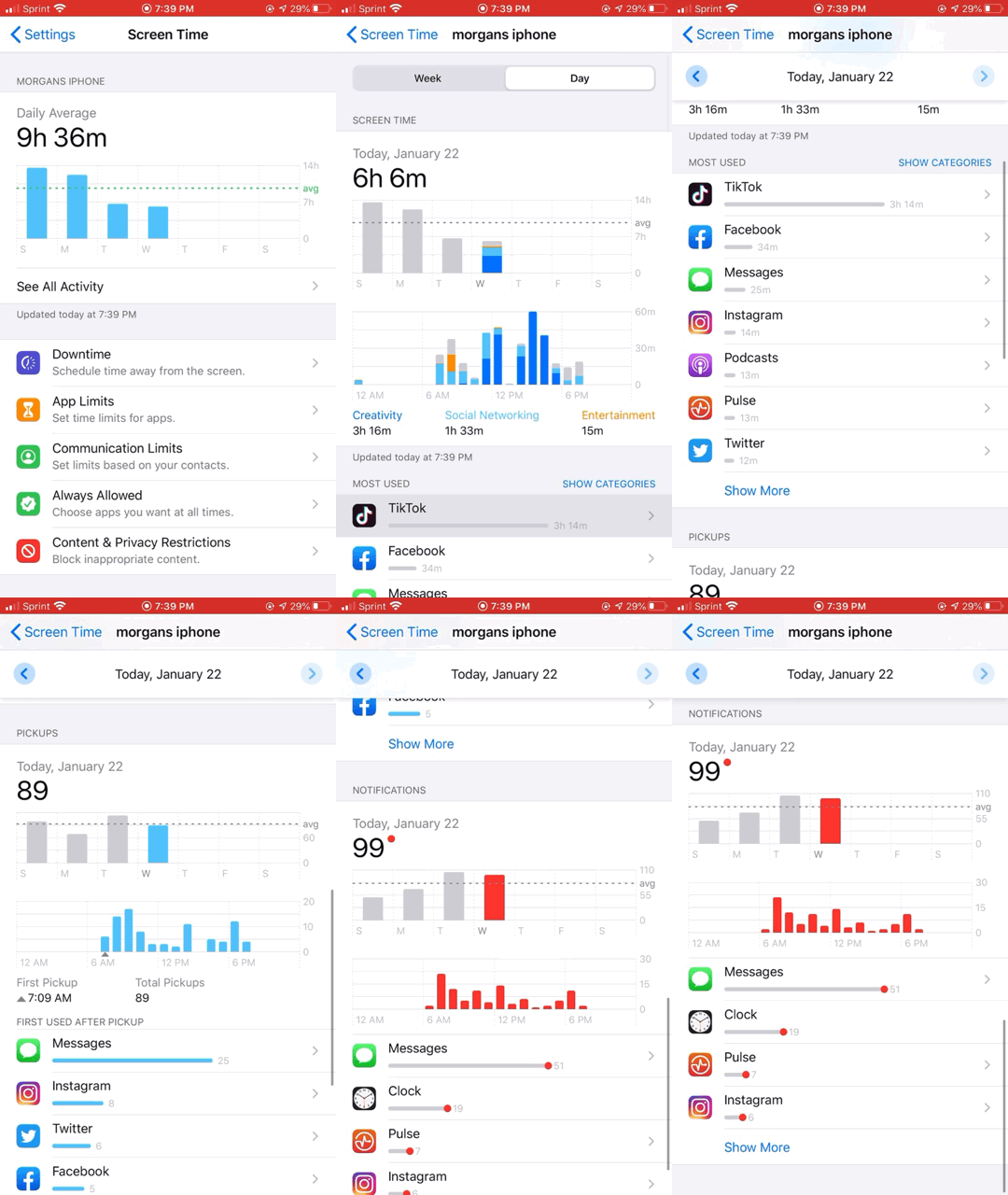
It wasn’t until I paid closer attention to my social media use for this blog post that I realized the true extent of my addiction to it. iPhone recently introduced a new “Screen Time” feature that tracks the amount of time you spend on your phone a day, which apps you tap on, and how long you get sucked into spending on them. I don’t usually look at it, but on Wednesday before bed, I did. Here’s what I saw:

Total, I spent over six hours using my phone. Half of that time was spent on TikTok. That number is nothing compared to my screen time average for the past week, which was a cringeworthy nine and a half hours a day. That’s nearly 40% of my time spent staring at my screen – a way larger percentage than the average 28% that we discussed in class. I could have used that time to study, write in my journal, practice doing my makeup, or nurture other hobbies and skills I neglect in favor of the internet. I realized that I rely on social media and my phone a lot more than I was even conscious of. I knew the next day, the day I had chosen to detox from social media, was going to be tougher than I thought.

Spoiler alert: it wasn’t. I’ll admit I didn’t leave my phone in a drawer all day, but I did set myself some rules. I could use iMessage to get in contact with my boyfriend and my mom, I could check my emails, listen to podcasts and watch Netflix. No Facebook, no Twitter, no Instagram, no Pinterest, no TikTok, no Snapchat. The two weirdest parts of the day were immediately when I woke up and the lull of the evening – both times I typically dedicate to scrolling. Most notably, my day without social media was so much more productive than a typical day. The pockets of time I usually waste on TikTok and YouTube were filled with reading my textbooks, working on assignments I’d procrastinated earlier in the week, and planning out February’s pages in my bullet journal. Rather than deriving satisfaction from likes on my new Facebook profile picture and favorites on my most recent tweet, I found it in accomplishing real-life goals that made me feel organized and responsible. In total, I spent just under six hours using my phone during my detox day. Over half of this was spent watching a docuseries on Netflix and facetiming with my mom, so save for that, I only spent one-third of my average amount of time on my phone.

Communication was not as difficult as I thought it would be. I had a few Snapchat and Facebook messages that went unanswered, but the people I communicate with on a daily basis were able to reach me through iMessage or phone calls. This made me realize that the majority of time I spend on social media is passive and pretty shallow. I usually just look at the posts of other people rather than interacting with them or actively posting myself. Even though I have over 500 Facebook friends, I don’t really care about 90% of what shows up on my feed. My scrolling serves to pass the time, distract me, or keep me briefly entertained rather than keeping me meaningfully connected with people in my life. The meaningful connections I do have with others are built in-person, where I can let down my walls and stop feeling pressured to keep up a “perfect” image of myself. As Sophie Goodman pointed out in her article about online identity, “One thing that differs with Facebook friendships is the heavy weight placed on the presentation of a positive image.” I’ll admit it – the pictures I post for 1,000+ people to see on my Instagram are only a reflection of my greatest hair days, the best memories I have with my friends, or the successful moments in my life. Most of my followers don’t see me when I’m not wearing makeup or stress-crying about finals week. My boyfriend and my best friends do. These are the people that I love, and staying connected with them through social media is the most relevant way I use it. The rest is pretty superficial, and I now know that social media is not as important to my daily communication and relationship building as I thought.

After this experiment, I am considering adding a detox day into my weekly routine. I felt significantly more productive, better focused on my real-life goals, and in turn, less stressed out overall. Although I consider social media a large part of my day-to-day life, I recognize that too much ends up causing more harm than good. Without social media, I can put more time and energy into accomplishing my educational goals, nurturing my hobbies, and taking care of my mental health. This Self Care Sunday, my social profiles will be ignored so I can spend my time improving my real self – not my online image.

Design a site like this with WordPress.com
Get started