I’m not a huge sports fan. Every year, I get more excited about the Puppy Bowl than the actual football game (I’m an eighteen-year-old girl, who can blame me?). On Sunday, in fact, I timed my drive back to Milwaukee from Appleton so I’d be on the road right as the game started; it was my most traffic-free drive yet. I didn’t watch a second of the game, but I made it home in record time and still got the gist of the halftime show courtesy of people fighting on my Facebook timeline. Jokes aside, despite the fact that I don’t care about the game itself, I am still a sucker for a great Super Bowl commercial. I know other people can relate – it’s almost half the fun of the event. Companies who pay for airtime during the game really have to put their best advertising foot forward, because with just under 100 million people watching, there’s a lot of pressure to come up with something impactful.
Olay opened an interesting dialogue with their collaboration with Girls Who Code, an organization that teaches young women computer skills and helps encourage them to pursue jobs in computer science. The commercial featured five women, including Nicole Stott, Lily Singh, Busy Phillips, Taraji P. Henson and Katie Couric, all working together to send three women to space. The message of the ad was simple – make space for women! Olay, in addition to airing a seemingly empowering advertisement for millions of people to see, also promised that for every time the ad was shared on Twitter using the hashtag #MakeSpaceForWomen, they’d donate $1 to Girls Who Code. Here’s the ad, in case you haven’t seen it yet:
At first glance, I really liked this ad. It felt empowering, it highlighted a variety of successful women, and it promised to support the educational development of young women interested in STEM. I’m a young feminist, so I figured, what’s not to love? Turns out, there are a few things people weren’t super keen on.
I went to Twitter to gather some opinions, searching “Olay ad” and looking at the top posts. Most of these posts were other celebrity women praising the ad, sharing the hashtag and encouraging other women to do the same. It seemed to me that other people also loved the commercial – in fact, the data we looked at in class confirmed that Olay had one of the most successful campaigns in terms of positive sentiment. To be clear, most of the comments were positive, many of them applauding Olay for supporting Girls Who Code and bringing women into the spotlight of computer science. Others, however, felt that the commercial was too cheesy for such an important topic, even making women seem “ditzy” after one of them accidentally hit the eject button in the space craft at the end of the ad. Several Twitter users expressed that the end of the ad sort of “blew the whole message,” and that Olay’s money may have been better spent elsewhere. Here’s an interesting exchange I saw:
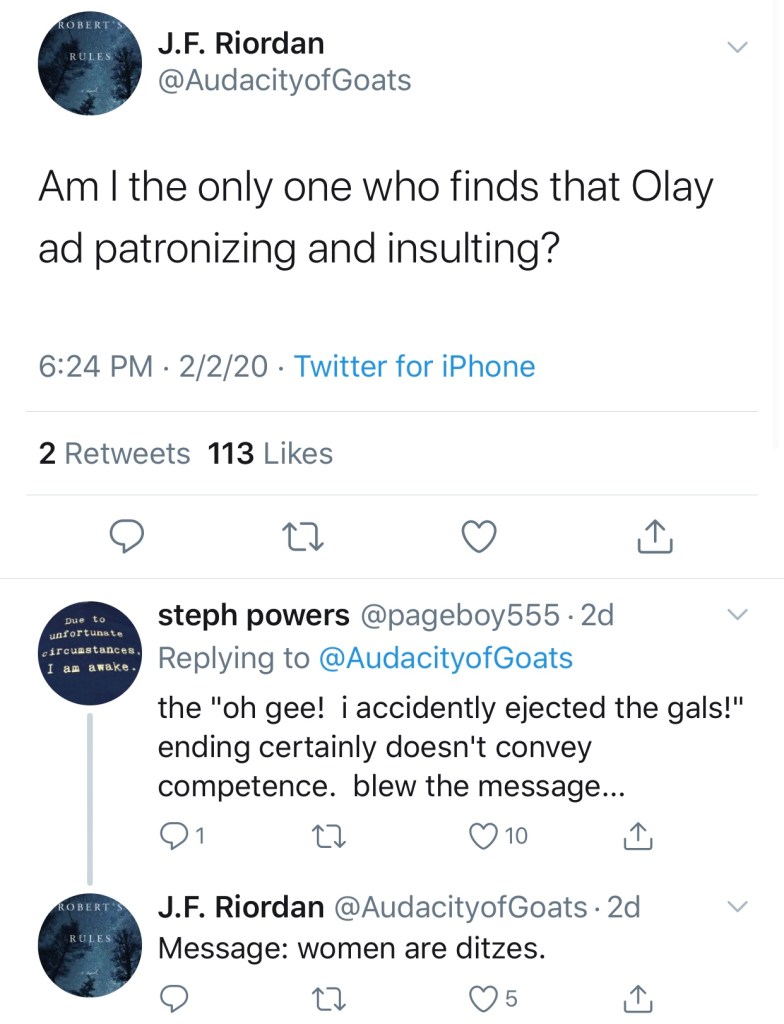
I hadn’t considered this point of view before I came across it online. I have to say, I kind of agree! The whole ad did feel a little silly after I watched it again with a new perspective. I still like the concept and I support a partnership with Girls Who Code, but the creative direction and planning for this campaign could have taken the issue more seriously and portrayed women in a more professional light.
Another issue several users brought up on Twitter was the fact that Olay guaranteed a donation to Girls Who Code, but only up to $500,000. Several people pointed out that it was a pretty skimpy contribution considering Olay had over five million dollars to spend on their advertisement – couldn’t they have just donated that to Girls Who Code instead? I’ll say this also impacted my opinion about the advertisement as a whole. Again, I agree – not only did Olay turn some women off with their ditsy portrayal of women in science, but they turned others away with their seemingly selfish financial priorities. I understand the company has to spend advertising dollars for their own benefit, too, but why spend so much money on telling people you’re donating rather than just donating? It was an interesting point to consider, and many online shared their thoughts about it. Here are a few examples I saw:
I see what Olay was trying to do. Really, I do! Honestly, I think any ad campaign that focuses on supporting young women and organizations that help young women is worth paying attention to. But in 2020, it is more important than ever for ads like this to portray women in ways that don’t counter constant social efforts to help women be taken seriously. Also, people are right to be skeptical about the amount Olay donated. The ad itself cost ten times more than the amount they’re donating – was it really a great allocation of their resources? That’s up for debate.
In general, the collaboration with Girls Who Code was well-supported by comments that I saw on Twitter, so although the skit for this ad wasn’t received well by everyone, at least a donation will be made to an organization that promotes intelligence and professionalism in young women. If you’re interested in learning more about Girls Who Code or donating to their cause, I’ve linked to their website. You can click here to go to their donation page.
 Welcome!